
Borrow Smarter, Not Harder
Borrowing is a common and often necessary step for many small and medium-sized enterprises (SMEs). However, borrowing should never be approached as a quick fix for financial pressure. When used correctly, financing can support business growth, strengthen operations, and unlock opportunities. When used poorly, it can create unnecessary financial strain. Borrowing smarter means understanding why financing is needed, choosing the right type of funding, and ensuring the business can comfortably manage repayment. What Smart Borrowing Really Means Smart borrowing is about making informed financial decisions that support the long-term health of a business. It involves: Borrowing for a clear business purpose. Selecting financing that matches the business cash flow cycle. Understanding repayment terms before accepting funding. Avoiding unnecessary or excessive borrowing. Responsible borrowing ensures that financing becomes a tool for growth rather than a financial burden. Why Businesses Sometimes Borrow the Wrong Way Many SMEs fall into borrowing challenges not because they lack discipline, but because they lack access to clear financial guidance. Some common borrowing mistakes include: Borrowing without a defined purpose. Taking short-term loans for long-term investments. Underestimating repayment obligations. Borrowing multiple loans simultaneously to cover operational gaps. These decisions can place pressure on business cash flow and limit the ability to reinvest in growth. Borrowing Should Support Growth, Not Survival Financing works best when it supports productive business activities. Responsible borrowing can help SMEs: Fulfil contracts and purchase orders. Manage temporary cash flow gaps. Invest in productive assets or equipment. Expand operations to meet growing demand. When financing is tied to real business opportunities, it becomes a strategic tool rather than emergency support. Practical SME Scenarios Scenario 1: Financing a Business Opportunity An SME secures a confirmed contract but needs funds to purchase materials and pay workers upfront. Instead of declining the opportunity due to lack of cash, the business uses contract financing to complete the project. Once the client pays, the financing is repaid. The loan becomes a bridge to growth rather than a financial burden. Scenario 2: Managing Cash Flow Responsibly A business supplies goods to corporate clients who pay after 30 to 60 days. Instead of struggling with daily expenses while waiting for payment, the business uses invoice discounting to unlock cash tied up in receivables and maintain smooth operations. Scenario 3: Investing in Productive Assets A small manufacturing business wants to purchase equipment that will increase production capacity. Instead of draining working capital, the business uses structured financing with manageable repayments aligned to increased revenue. This allows the business to grow without disrupting day-to-day operations. Questions SMEs Should Ask Before Borrowing Responsible borrowing begins with asking the right questions. Before taking financing, SMEs should consider: What exactly will the funds be used for? Will this financing generate income or improve operations? Can the business comfortably manage the repayments? Does the loan structure match the business cash flow cycle? These questions help ensure that borrowing supports stability rather than creating pressure. The Importance of Financial Discipline Borrowing responsibly also requires strong financial habits. Businesses can strengthen their borrowing readiness by: Keeping basic financial records. Tracking cash flow regularly. Understanding seasonal income patterns. Avoiding borrowing for non-productive expenses. Financial discipline builds credibility with lenders and improves access to future financing opportunities. Why Responsible Borrowing Matters for Lesotho’s SME Sector When SMEs borrow responsibly, the benefits extend beyond individual businesses. Healthy borrowing practices: Reduce business failure caused by unsustainable debt. Strengthen the SME financing ecosystem. Encourage financial inclusion and trust between lenders and businesses. Support job creation and economic stability. Responsible financing contributes to a stronger and more resilient SME sector. Final Thoughts Borrowing should never be about accessing the fastest money available. It should be about accessing the right financing at the right time for the right purpose. Smart borrowing allows SMEs to grow with confidence, maintain financial stability, and build businesses that can thrive over the long term. At Prime Capital, we believe that access to finance must go hand in hand with financial responsibility. Our financing solutions are designed to support productive business activity while encouraging informed and sustainable borrowing. Follow Prime Capital for insights on SME growth, responsible financing, and practical tools that help businesses build strong financial foundations. Borrowing is powerful when used wisely. Borrow smarter, not harder.
Access to Capital: A Game-Changer for SMEs
Moving SMEs From Survival to Sustainable Growth For many SMEs in Lesotho, growth does not fail because of lack of ideas, effort, or customers. It fails because of limited access to the right type of capital at the right time. Access to capital is not simply about getting a loan. It is about unlocking opportunity, strengthening operations, and enabling businesses to move from survival mode into sustainable growth. What Access to Capital Really Means Access to capital means having timely, appropriate, and affordable financing that aligns with how a business operates. This includes capital that allows SMEs to: Execute contracts and purchase orders. Manage cash flow gaps caused by late client payments. Invest in equipment, stock, or systems. Respond quickly to growth opportunities. Without access to capital, even profitable businesses can stall. Why Lack of Capital Holds SMEs Back Many SMEs face challenges not because demand is low, but because: They must cover upfront costs before getting paid. Cash is locked in unpaid invoices. Growth opportunities require immediate investment. Business income is seasonal or irregular. When these challenges are not addressed, businesses may miss contracts, delay growth, or rely on expensive emergency borrowing. Capital as a Growth Enabler, Not a Lifeline Well-structured capital does more than solve short-term problems. It enables growth. When SMEs have access to capital: They can fulfill contracts confidently. They can maintain stock and meet customer demand. They can invest in systems and people. They can build credibility with suppliers and clients. Capital allows businesses to plan forward instead of reacting under pressure. Access to Capital in Practice: Real SME Scenarios Scenario 1: Executing a Contract An SME secures a service contract but needs funds to cover labour and materials upfront. Without financing, the opportunity may be lost. With contract financing, the business delivers the work, receives payment, and repays financing from completed income. The contract becomes a growth milestone rather than a risk. Scenario 2: Managing Cash Flow A growing business issues invoices but waits weeks for payment. Operations slow due to lack of cash. Through invoice discounting, the business unlocks cash tied up in receivables and continues operating smoothly while waiting for client payments. Scenario 3: Meeting Demand A business receives confirmed purchase orders but cannot afford to buy stock upfront. Purchase order financing enables the business to fulfil orders, increase sales, and strengthen customer relationships. These scenarios show that access to capital is often the difference between missed opportunity and sustained growth. Why SME Readiness Matters Access to capital works best when businesses are prepared. SMEs improve their chances of accessing finance by: Keeping basic financial records. Understanding cash flow cycles. Clearly defining the purpose of financing. Borrowing amounts aligned with repayment capacity. Responsible access to capital protects both the business and the financier. The Role of Responsible Financing Not all capital supports growth. Poorly structured financing can strain cash flow and weaken a business. Responsible financing: Matches funding to business needs. Aligns repayments with income cycles. Encourages financial discipline. Supports long-term sustainability. This approach turns financing into a growth partner, not a burden. Why Access to Capital Matters for Lesotho’s Economy When SMEs grow, the economy grows. Improved access to capital: Supports job creation. Strengthens local value chains. Increases business formalisation. Builds economic resilience at community level. Supporting SMEs is not just good for business owners. It is good for Lesotho. Final Thoughts Access to capital is one of the most powerful tools for SME growth. When it is timely, appropriate, and responsibly structured, it enables businesses to scale, stabilise, and succeed. Growth should not depend on luck. It should be supported by access to the right financial tools. At Prime Capital, we understand that SMEs need more than funding. They need financing that fits their operations, cash flow, and growth stage. That is why we offer structured solutions such as contract financing, purchase order financing, invoice discounting, and working capital support, alongside practical financial guidance. Follow Prime Capital for insights on SME growth, access to finance, and building businesses that are resilient, credible, and built to last. Access to capital changes businesses. Responsible access changes futures.
Investing With Purpose: Sustainable Investing
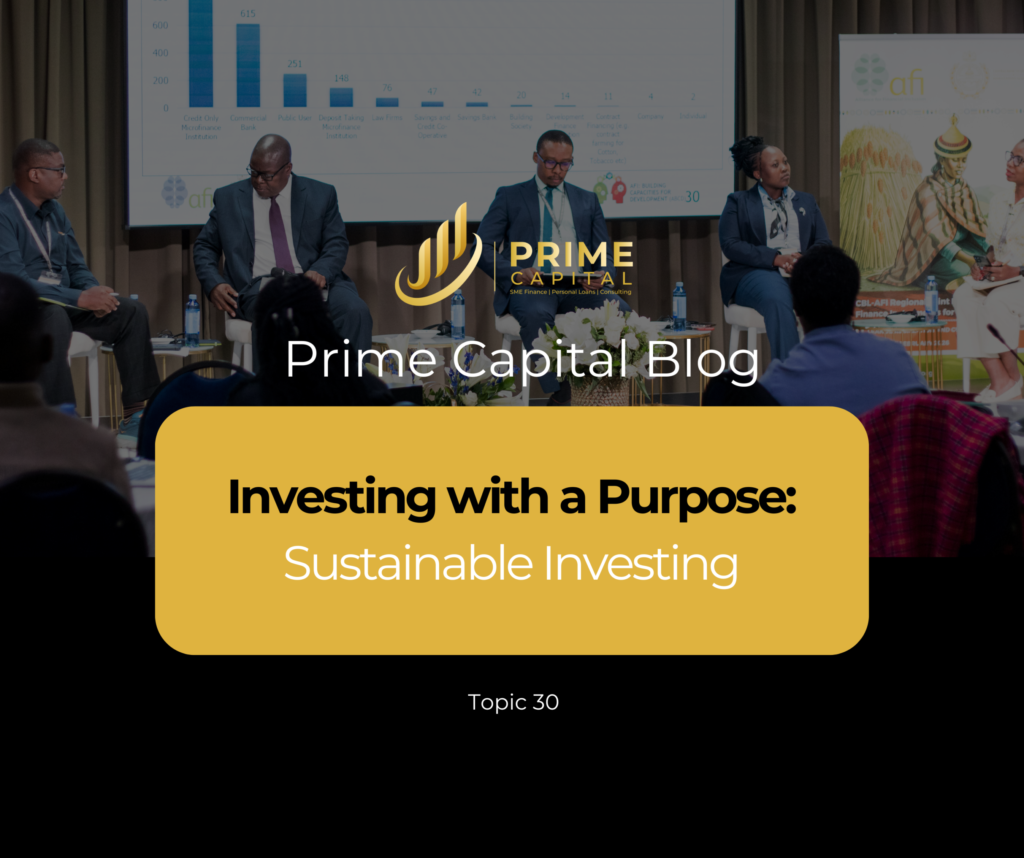
Growing Your Money While Creating Long-Term Impact When people hear the word investing, they often think of wealth, returns, and growth. But investing can be about more than just financial gain. Sustainable investing is about growing money in ways that also support long-term social, environmental, and economic wellbeing. For individuals and SMEs in Lesotho, investing with purpose means making financial decisions that are not only profitable, but also responsible and future-focused. What Is Sustainable Investing? Sustainable investing is an approach that considers both financial returns and long-term impact. It looks at how money is used, not just how much is earned. This includes: Supporting businesses that operate responsibly. Investing in activities that protect resources and communities. Prioritising long-term stability over short-term gains. Sustainable investing recognises that strong economies depend on healthy people, ethical practices, and resilient systems. Why Sustainable Investing Matters Short-term decisions may bring quick returns, but they often come with long-term costs. Sustainable investing matters because it: Encourages responsible business practices. Reduces financial risk linked to environmental and social challenges. Supports businesses that are built to last. Aligns financial growth with community development. For SMEs, sustainability is not a luxury. It is a strategy for survival and growth. What Sustainable Investing Looks Like in Practice Sustainable investing does not always require large amounts of capital. It often starts with everyday decisions. Examples include: Investing in energy-efficient equipment to reduce operating costs. Supporting businesses that treat employees fairly and ethically. Choosing suppliers with responsible practices. Reinforcing good governance, transparency, and accountability within a business. These choices strengthen long-term performance and resilience. Sustainable Investing for SMEs For SMEs, sustainable investing often means investing back into the business responsibly. This may include: Improving operational efficiency to reduce waste. Strengthening internal policies and compliance. Investing in staff skills and productivity. Building systems that support long-term growth rather than quick wins. These investments improve credibility, reduce risk, and make businesses more attractive to partners and financiers. Balancing Profit and Purpose Sustainable investing does not mean sacrificing profit. It means balancing profit with purpose. Businesses that operate sustainably often: Experience lower long-term costs. Build stronger customer trust. Attract better partnerships and financing opportunities. Perform better over time due to reduced risk exposure. Purpose-driven decisions strengthen financial outcomes rather than weaken them. Final Thoughts Investing with purpose is about thinking beyond today. It is about building financial growth that does not compromise the future. Whether you are an individual planning your finances or an SME making business investments, sustainability helps ensure that progress today does not become a problem tomorrow. At Prime Capital, we believe sustainable growth comes from responsible financial decisions. We support individuals and SMEs who invest with intention, discipline, and long-term impact in mind. Follow Prime Capital for insights on sustainable investing, responsible financing, and building resilient businesses that grow with purpose. The best investments are those that strengthen both your finances and your future.
Building Financial Resilience
How SMEs Can Prepare for Uncertainty and Stay Financially Strong For many SMEs, uncertainty is not an occasional challenge. It is part of doing business. Late payments, rising input costs, seasonal demand, and unexpected disruptions can quickly place pressure on cash flow. Financial resilience is not about avoiding challenges. It is about having the capacity to absorb shocks, adapt, and continue operating without collapsing. Below are real-world scenarios that show what financial resilience looks like in practice. What Financial Resilience Means for SMEs For small businesses, financial resilience means being able to: Continue operating during slow periods. Meet financial obligations even when clients delay payment. Adjust quickly when costs rise or demand changes. Recover without taking on unmanageable debt. Resilience is built intentionally, not by luck. SME Scenario 1: Managing Late Client Payments A service-based SME completes work for a client but payment is delayed by 30 to 60 days. Without cash inflow, the business struggles to pay staff and suppliers. A resilient business: Has some cash buffer in place. Uses structured financing such as invoice discounting to unlock cash tied up in invoices. Continues operating without defaulting on obligations. Without resilience, the business may miss payments or take on expensive emergency loans. SME Scenario 2: Rising Input Costs A small manufacturing or retail business experiences rising costs for raw materials or stock. Profit margins tighten, and cash flow becomes strained. A resilient business: Reviews pricing and costs regularly. Adjusts operations to protect margins. Uses working capital financing strategically to stabilise operations during the adjustment period. Resilience allows time to adapt rather than react in panic. SME Scenario 3: Seasonal or Irregular Income Some SMEs experience fluctuating income due to seasonality or project-based work. A resilient business: Plans ahead during strong months. Sets aside reserves to support slower periods. Aligns repayments and expenses with realistic cash flow cycles. Without planning, seasonal downturns can become financial crises. SME Scenario 4: Winning a Contract Without Upfront Capital An SME secures a contract but lacks funds to cover upfront costs such as labour, materials, or logistics. A resilient business: Understands its financing options. Uses contract financing to deliver the work. Repays financing from completed contract income. This approach turns opportunity into growth instead of stress. Key Habits That Strengthen SME Resilience Financially resilient SMEs often share these habits: Keeping basic but accurate financial records. Separating business and personal finances. Monitoring cash flow regularly. Borrowing with purpose and planning for repayment. Building small reserves over time. These habits create flexibility and confidence during uncertain periods. Final Thoughts Financial resilience is not about being immune to challenges. It is about being prepared to face them without losing stability. SMEs that plan, monitor, and use finance responsibly are better positioned to survive uncertainty and grow sustainably. At Prime Capital, we understand the realities SMEs face. That is why we support businesses with practical financial guidance and financing solutions designed to strengthen resilience, manage cash flow, and support sustainable growth. Follow Prime Capital for insights on building resilient businesses, managing uncertainty, and making informed financial decisions that protect your future. Resilience is not built in good times alone. It is built by how you prepare for the difficult ones.
Taking Control of Debt
Debt Management Strategies for a Healthier Financial Future Taking Control of Debt Without Stress or Shame Debt is a reality for many individuals and businesses. Whether it is a personal loan, business financing, or short-term credit, debt can be useful or harmful depending on how it is managed. The goal is not to eliminate debt at all costs. The goal is to manage debt responsibly, so it supports your financial wellbeing instead of overwhelming it. 1. Understand Your Full Debt Picture The first step to managing debt is clarity. Make sure you know: How many loans you have. The outstanding balance on each loan. The interest rates and repayment schedules. The total amount you repay each month. Without this information, it is difficult to make informed decisions. 2. Prioritise High-Cost Debt Not all debt costs the same. A healthy strategy includes: Identifying loans with the highest interest rates. Prioritising repayment of high-cost debt first where possible. Avoiding taking new debt to repay existing debt without a plan. Reducing expensive debt early can ease long-term financial pressure. 3. Align Repayments With Your Income or Cash Flow Debt should fit your financial reality. Good debt management means: Ensuring repayments are affordable even during slow months. Planning loan repayments as part of your budget. Avoiding over-commitment that strains cash flow. For SMEs, repayments should align with business revenue cycles. 4. Avoid Borrowing to Fix Ongoing Problems Borrowing should solve a specific problem, not cover ongoing losses. Warning signs include: Taking loans repeatedly to pay day-to-day expenses. Using new loans to repay old ones without addressing the root issue. Borrowing without a clear purpose or repayment plan. In these cases, reviewing spending or business operations may be more effective than borrowing. 5. Communicate Early if You Are Struggling If repayments become difficult, ignoring the problem makes it worse. A healthier approach includes: Communicating early with your lender. Exploring possible repayment adjustments. Seeking financial guidance before arrears build up. Responsible lenders value transparency and proactive communication. 6. Use Debt as a Tool, Not a Lifestyle Debt works best when it supports growth, opportunity, or stability. Healthy borrowing habits include: Using debt for income-generating or value-adding purposes. Reviewing borrowing decisions regularly. Avoiding lifestyle inflation funded by loans. Debt should support your goals, not replace planning. 7. Build Habits That Reduce Future Debt Long-term debt management includes prevention. Helpful habits include: Saving for emergencies. Budgeting realistically. Improving financial literacy and record-keeping. These habits reduce the need for unplanned borrowing. Final Thoughts Managing debt is not about perfection. It is about awareness, planning, and consistency. When debt is managed well, it becomes a tool that supports progress rather than a burden that creates stress. Call to Action At Prime Capital, we support responsible borrowing and proactive debt management. We work with individuals and SMEs to ensure financing decisions are informed, realistic, and aligned with long-term financial health. Follow Prime Capital for practical guidance on managing debt, building financial resilience, and making confident financial decisions that support sustainable growth. A healthier financial future starts with how you manage debt today.
Financial Literacy Is Power

Why Understanding Money Is the Foundation of Long-Term Success Financial literacy is more than knowing how to save or budget. It is about understanding how money works and using that knowledge to make informed decisions that support your goals. Whether you are managing personal finances, running a small business, or planning for the future, financial literacy gives you control, confidence, and choice. In today’s economy, financial literacy is no longer optional. It is essential. What Financial Literacy Really Means Financial literacy is the ability to understand and manage money effectively. This includes: Knowing how to budget and track expenses. Understanding borrowing, interest rates, and repayment obligations. Planning for savings, emergencies, and future goals. Making informed financial decisions for both personal and business needs. It is not about being an expert. It is about having enough knowledge to avoid costly mistakes and make money work for you. Why Financial Literacy Matters for Individuals For individuals and households, financial literacy: Reduces financial stress and uncertainty. Helps prevent over-borrowing and unmanageable debt. Encourages saving and long-term planning. Supports better decision-making during economic challenges. When people understand their finances, they are less likely to live reactively and more likely to plan intentionally. Why Financial Literacy Matters for SMEs For small businesses, financial literacy is directly linked to survival and growth. Financially literate business owners are better able to: Manage cash flow effectively. Understand the true cost of borrowing. Price products and services sustainably. Prepare for financing and growth opportunities. Many SMEs struggle not because they lack customers, but because they lack financial systems and knowledge to manage growth. Financial Literacy Builds Confidence When you understand money, you ask better questions. You negotiate better. You plan better. Financial literacy: Empowers you to engage confidently with lenders and partners. Helps you assess opportunities realistically. Reduces fear and confusion around financial decisions. Confidence comes from clarity, and clarity comes from understanding. Financial Literacy Is a Continuous Journey Learning about money does not stop at one workshop, one blog, or one loan. Financial literacy is built over time through: Continuous learning. Practical application. Reviewing and adjusting financial habits. Each step forward strengthens your financial foundation. Final Thoughts Financial literacy is one of the most powerful tools you can have. It influences how you earn, spend, save, borrow, and grow. When people and businesses are financially literate, they are better equipped to build resilience, seize opportunities, and create sustainable futures. At Prime Capital, we believe access to finance should go hand in hand with access to knowledge. That is why we are committed to promoting financial literacy alongside responsible financing solutions for individuals and SMEs. Follow Prime Capital for practical insights, tools, and guidance designed to help you make informed financial decisions and build long-term financial confidence. Knowledge is power. Financial literacy turns that power into progress.
Fueling Growth: Innovative Financing for SMEs
Fueling Growth: How Innovative Financing Can Unlock SME Potential Financing That Matches How Businesses Actually Operate For many SMEs in Lesotho, growth is not limited by ideas or effort. It is limited by cash flow timing. Businesses often have confirmed work, orders, or invoices, but struggle because money is needed before payments are received. This is where innovative financing becomes essential. It is not about borrowing for survival. It is about bridging gaps, unlocking opportunities, and enabling growth in a way that aligns with how businesses operate in the real world. Why One-Size-Fits-All Financing Does Not Work Traditional loans alone are not always suitable for SMEs. Many businesses do not fail because they are unprofitable, but because: Clients pay late. Contracts require upfront costs. Stock must be purchased before sales are made. Cash is tied up in unpaid invoices. Innovative financing responds to these realities by focusing on cash flow cycles, not just balance sheets. Innovative Financing Solutions for SMEs Innovative financing is designed to support businesses with active operations and real demand. Examples include: Contract Financing When an SME has secured a contract but lacks funds to execute it, contract financing provides the working capital needed to deliver the service or product. This allows businesses to fulfil contracts without financial strain. Purchase Order Financing When a business receives a confirmed purchase order but cannot afford to buy stock upfront, purchase order financing enables the business to meet demand and complete the sale. Invoice Discounting When a business has issued invoices but is waiting for payment, invoice discounting unlocks cash tied up in receivables. This helps businesses maintain operations while waiting for clients to pay. Working Capital Financing Working capital financing supports day-to-day business operations, such as covering operational expenses, managing seasonal demand, or stabilising cash flow during growth periods. Each of these solutions addresses a specific cash flow challenge faced by SMEs. SME Scenario: Turning Opportunity Into Growth A service-based SME secures a contract with a large client but must cover labour and materials upfront. Without financing, the opportunity could be lost. Through contract financing, the business is able to deliver the contract, receive payment, and repay the financing from completed work. The business grows without disrupting operations. In this case, financing enables opportunity, not debt dependency. Why Readiness Matters Innovative financing works best when businesses are prepared. This includes: Valid contracts, purchase orders, or invoices. Clear understanding of costs and timelines. Basic financial records. A defined purpose for financing. Responsible financing depends on transparency and planning, protecting both the business and the lender. Responsible Financing Builds Sustainable Businesses Innovative financing should never create unnecessary pressure. Responsible financing: Matches funding to actual business needs. Aligns repayments with cash inflows. Supports growth without overburdening the business. At Prime Capital, financing is structured with sustainability in mind. The focus is on helping SMEs grow responsibly and confidently. Final Thoughts Access to the right type of finance can be the difference between missing an opportunity and unlocking growth. When financing aligns with business operations, cash flow challenges become manageable, and growth becomes achievable. At Prime Capital, we provide financing solutions designed around how SMEs actually operate. From contract financing and purchase order financing to invoice discounting and working capital support, our approach focuses on enabling growth while promoting financial discipline. Follow Prime Capital for practical insights on financing, cash flow management, and building resilient businesses. When finance fits your business model, growth becomes sustainable.
Opportunities Are Here: How Youth and Women Can Win
Opportunities Are Here: How Youth and Women Can Win in Lesotho Making the Most of Financial and Entrepreneurial Opportunities in 2026 Youth and women in Lesotho are not just observers of the economy anymore. Across sectors, business development, agriculture, finance, and skills training; there are real, growing opportunities for Basotho youth and women to start, grow, and scale their enterprises. The key is knowing where opportunities exist and how to tap into them with confidence and a plan. Here’s a clear, practical look at what’s available and how to seize it: 1. National and Government-Backed Initiatives Supporting Entrepreneurs Lesotho’s National Strategic Development Plan deliberately includes strategies to boost job creation and enterprise development for youth and women. These include support for creating jobs in sectors like tourism, agriculture, and services. Youth and women are seen as key drivers of economic growth and targets of programmes aimed at improving employment and business opportunities. 2. Competitiveness and Financial Inclusion Support The Competitiveness and Financial Inclusion (CAFI) Project is one of Lesotho’s flagship initiatives aimed at strengthening private sector participation and inclusion, with specific measures that benefit youth- and women-owned businesses. It provides: Access to seed funding and partial credit guarantees for MSMEs. Training and technical support. Targeted support to youth- and women-owned enterprises to increase revenue and employment. This project aims to make business support services more accessible and to lower barriers to formal financing. 3. Mentorship and Entrepreneur Programmes Lesotho has several programmes designed to equip young people and women with business skills: Lesotho National Youth Entrepreneurs Mentorship Programme (LNYEMP) provides mentorship and practical business guidance to help young entrepreneurs grow sustainable ventures. Other initiatives like the Sebabatso Youth Entrepreneurship Initiative and the EYES Project offer training, innovation support, and networking opportunities that help entrepreneurs refine ideas and build business skills. These programmes focus on real-world business skills such as financial planning, market access, and product development. 4. Agriculture and Value Chain Opportunities Agriculture and related value chains remain a major source of income for youth and women in Lesotho. Horticulture incubation programmes offer: Training in climate-smart agriculture. Technical assistance on soil health, irrigation, and marketing. Support accessing mechanisation and value addition services. These programmes help youth and women move from subsistence farming to commercial agriculture, boosting profitability and sustainability. 5. Partnerships and Skills Empowerment Initiatives Partnerships between organisations such as UNDP and Lesotho Post Bank (LPB) are making tangible improvements in access to financial resources for youth and women entrepreneurs. Their collaboration focuses on: Financial literacy training. Capacity building to become employers rather than job seekers, Support for business plan development and accessing markets beyond Lesotho, including through AfCFTA (African Continental Free Trade Area) opportunities. This approach equips entrepreneurs with the skills and confidence to expand and participate in broader markets. 6. Local Innovation and Private Sector Engagement Lesotho’s entrepreneurial ecosystem is also growing through local innovation hubs and incubators that provide: Seed funding and mentorship. Workshops and networking events. Opportunities to refine business ideas and connect with partners. Youth and women who engage with these hubs can accelerate learning and access early-stage support often missing in informal settings. How to Make These Opportunities Work for You You don’t just wait for change; you position yourself for it. Here’s how: Upskill yourself: Attend training in financial literacy, business planning, and digital skills through local programmes or partners. Network: Join business associations, mentorship circles, and youth forums to exchange ideas and find collaborators. Apply early: Opportunities like seed funds, incubation cycles, and mentorship programmes are competitive. Apply as soon as applications open. Formalise your business: Even simple business registration increases eligibility for finance and formal support. Keep learning: Entrepreneurship is a journey, not a destination; stay informed and adaptable. Final Thought Lesotho’s economy is evolving, and youth and women are increasingly at its centre. With the right information, preparation, and support, what felt like potential just a few years ago can become real opportunities to grow businesses, create jobs, and build resilient futures. At Prime Capital, we are committed to empowering you through both access to finance and financial knowledge. Whether you’re exploring seed capital, refining your business model, or preparing to formalise your enterprise, we are here to support you with relevant insights and structured financing options. Follow Prime Capital for more content on opportunities, practical guidance, and tools that help youth and women in Lesotho grow with confidence. Your success is part of Lesotho’s story.
Why SMEs Matter: The Backbone of Lesotho’s Economy
Understanding the Role of Small Businesses in Growth, Jobs, and Community Development Small and Medium Enterprises, often referred to as SMEs, are more than just businesses. In Lesotho, they are the backbone of the economy. From informal traders and small retailers to growing service providers and manufacturers, SMEs play a critical role in creating jobs, generating income, and supporting communities. Yet, despite their importance, many SMEs operate with limited resources, limited access to finance, and limited support. Understanding why SMEs matter is the first step toward creating an environment where they can thrive. SMEs Create Jobs and Livelihoods One of the most important contributions of SMEs is employment. Small businesses provide income for owners, employees, and families, especially in communities where formal employment opportunities are limited. In many cases, SMEs: Employ local people. Provide first job opportunities for youth. Support households through stable income Every successful SME does not just change one life. It supports many. SMEs Drive Local Economic Activity SMEs keep money circulating within communities. When a small business buys supplies locally, hires locally, and sells locally, it strengthens the local economy. This ripple effect: Supports other small businesses. Encourages entrepreneurship. Builds economic resilience at community level. A strong SME sector contributes to a more balanced and inclusive economy. SMEs Encourage Innovation and Entrepreneurship Small businesses are often more flexible and innovative. They adapt quickly to customer needs, test new ideas, and respond to market changes faster than larger organisations. In Lesotho, SMEs are: Exploring new value chains in agriculture and services. Introducing local solutions to everyday problems. Creating products and services tailored to local markets. Innovation does not only happen in big companies. It happens in small businesses every day. SMEs Support Youth and Women Empowerment Many SMEs in Lesotho are started and run by youth and women. For these groups, entrepreneurship is not just a choice. It is often a pathway to independence, dignity, and long-term stability. Supporting SMEs means: Supporting youth participation in the economy. Supporting women-owned businesses. Reducing inequality through inclusive growth. When SMEs grow, opportunities expand for everyone. Challenges Facing SMEs Despite their importance, SMEs face real challenges, including: Limited access to affordable finance. Weak financial management systems. Informality and lack of registration. Limited market access. Addressing these challenges requires both financial support and practical guidance. Why Supporting SMEs Is a Shared Responsibility SMEs cannot grow in isolation. Their success depends on: Access to finance. Financial literacy and business skills. Supportive policies and partnerships. Responsible lending practices. When these elements come together, SMEs are better positioned to grow sustainably and create long-term impact. Final Thoughts SMEs are not small in impact. They are essential to economic growth, job creation, and community development in Lesotho. Supporting SMEs means supporting the future of the economy. At Prime Capital, we recognise the critical role SMEs play in Lesotho’s development. That is why we focus on responsible lending, practical financial guidance, and long-term partnerships that help businesses grow sustainably. Follow Prime Capital for insights, tools, and support designed to strengthen SMEs and empower entrepreneurs to build resilient businesses. Strong businesses build strong communities.
Smart Borrowing 101: Good Debt vs. Bad Debt
Smart Borrowing 101: Understanding Good Debt vs. Bad Debt Making Borrowing Work for You, Not Against You Borrowing money is often misunderstood. Many people see debt as something to avoid completely, while others rely on it without fully understanding the consequences. The truth lies somewhere in between. Debt can either support growth or create strain, depending on how it is used. For individuals and SMEs in Lesotho, understanding the difference between good debt and bad debt is essential to building financial stability. What Is Good Debt? Good debt is borrowing that helps you grow, generate income, or strengthen your financial position. SME Scenario: Borrowing to Increase Production A small manufacturing business needs a machine that will double production capacity. The owner takes a loan to purchase the equipment, increases output, secures more clients, and uses the additional revenue to comfortably service the loan. In this case, borrowing supports growth. The debt has a purpose, a return, and a clear repayment plan. Good debt typically: Is tied to income generation. Has a clear business purpose. Is supported by realistic cash flow planning. What Is Bad Debt? Bad debt is borrowing that does not create long-term value and places pressure on finances. SME Scenario: Borrowing Without a Plan A small business owner takes a loan to cover ongoing expenses without addressing declining sales or poor cost control. The loan temporarily relieves pressure but does not improve income. Repayments become difficult, leading to missed payments and further borrowing. In this situation, debt masks the problem instead of solving it. Bad debt often: Is used for consumption rather than growth. Lacks a repayment strategy. Leads to repeated borrowing. Questions Every SME Should Ask Before Borrowing Before taking on debt, business owners should ask: What specific problem will this loan solve? Will this borrowing increase revenue or efficiency? Can the business service the loan even during slow months? Do I fully understand the interest rate, fees, and repayment schedule? Responsible lenders also ask these questions, because sustainable borrowing benefits both the borrower and the lender. Borrowing for Business Growth For many SMEs in Lesotho, access to finance is critical. When used responsibly, borrowing can support: Equipment purchases Stock financing Working capital during growth periods Business formalisation and compliance At Prime Capital, lending is guided by affordability, purpose, and long-term sustainability. Loans are structured to support business growth, not to create financial distress. The Role of Financial Literacy in Borrowing Understanding cash flow, interest rates, and repayment obligations helps business owners use debt wisely. Financial literacy allows borrowers to assess whether a loan makes sense before committing. Borrowing works best when it is paired with planning, record-keeping, and discipline. Final Thoughts Debt is not inherently good or bad. Its impact depends on how it is used. When borrowing is intentional, planned, and aligned with income generation, it becomes a tool for growth. When it is unplanned, it can quickly become a burden. The goal is not to avoid borrowing, but to borrow wisely and responsibly. At Prime Capital, we believe responsible lending creates strong businesses. That is why we partner with SMEs to assess needs, structure suitable financing, and support sustainable growth. If you are considering borrowing to grow your business, take time to understand your options and responsibilities. Follow Prime Capital for practical financial insights and guidance that help you make informed borrowing decisions with confidence. Building a business starts with smart financial choices.